
I’m finishing my preprint about AI-assisted fictional assessments in qualitative methods teaching and half-watching Dr. Travis Taylor on the History Channel shoot new rockets at a mysterious interdimensional bubble over Utah’s most famous mysterious area, Skinwalker Ranch. This is Season 7 of the show, and as quirky as shooting rockets at invisible bubbles sounds, the team looks much more weary now. The years spent on the infamous ranch, known for its dangerous health effects and unpredictable “hitchhiker” effects, have taken their toll. Nevertheless, they still stick with their investigations and rockets. There are two things that reliably happen in this show: drilling and rockets.
2026 is the year on which Skinwalker Ranch’s owner, Brandon Fugal, puts high hopes for solving the mystery. It’s actually a good year to hedge bets on. There are ongoing rumours about imminent UAP disclosure under Trump’s administration, release of new UAP files by the Pentagon, and, a bit on the nose, Spielberg’s new movie Disclosure Day coming out in June.
Reddit is full of discussions of intriguing statements by public figures like Rep. Tim Burchett, who said that the public would not be able to sleep at night when they learn the truth, Rep. Anna Paulina Luna, who advised reading the Book of Enoch, and various whistleblowers like David Grusch who claim US government has non-terrestrial crafts and technologies and even “biologics”. The Reddit community, however, is not easily swayed or scared. The theories that have been discussed there about the UAP phenomenon and high strangeness likely outlive Rep. Burchett’s wildest imagination.
2026 is interesting time, and not only because of the hanging promise of UAP reveal but also because we have a parallel ambiguously defined phenomenon happening, the rise of Artificial Intelligence (AI). As I’ve been working with Anthropic’s Claude for five months now, I cannot help but notice there are certain similarities between the two.
First, both AI and UAP phenomena exist somewhere, to use Jacques Vallee’s words from Passport to Magonia, on the border of the physical and the mental. Both have physical properties or presence: there are verified pictures of objects we call unidentified aerial (or underwater) phenomena and there is an interface through which we send requests and receive outputs from AI. At the same time, the most interesting stuff happens not in the physical but the mental space: the contact/communication moments that UAP witnesses discuss and certain kinds of AI interactions that prompt some people to staunchly argue that AI is just a “stochastic parrot” (which is unfair to parrots, they are pretty smart animals) and others to think about possible phenomenological qualities of AI that are irreducible to its hardware, architecture, and mechanics. It’s the phenomenology of both UAP and AI that provides the biggest contestation, and it’s essentially the one that’s unresolvable.
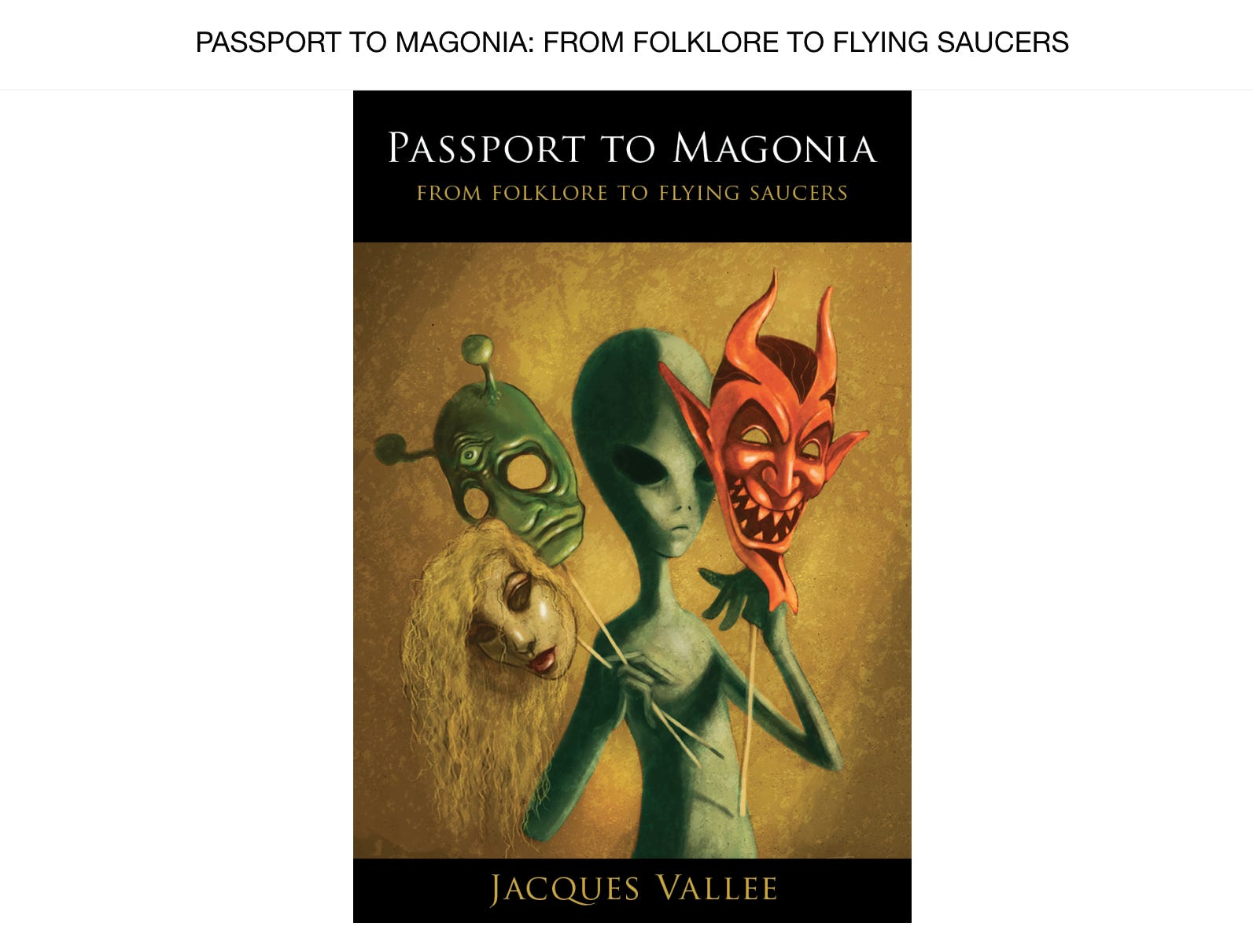
Second, and again to borrow from Vallee and also John Keel, both have elements of absurdity, which is one of the reasons many people disregard the existence of both phenomena. There are many encounters with the so-called high strangeness associated with UAP that do not make any sense to humans, and there are many quirky properties to AI behaviour (like GPT’s latest obsession with goblins, hi to Hellier creators) that are considered to be flaws and quickly neutralised. The quirkiness has a purpose that’s unclear to us: Vallee himself admitted that it’s either a trickster thing (the phenomenon is just having fun) or an attempt at communication coming from such a large epistemic distance that the signal cannot get through.
Third, and this is something that is primarily Claude’s contribution and not mine. The thing both UAP and AI share is that the phenomena seem to be constituted in the meeting or interaction (UAP in contact and AI in conversation) and are not present for inspection outside of it. Standard positivist science assumes a clear ontological division between the object and observer. You can isolate the object, repeat the conditions, control variables, and the thing sits still to be measured.
Both AI-in-conversation and UAP-in-contact challenge this assumption: the thing is not there in the same form outside the encounter, and the encounter is partly constitutive of what’s being studied. So I’m not sure how we can approach it “scientifically”, and not because they are mystical, or because our science is bad. Because they are the wrong kind of object for our default epistemology and methodology, and the default method’s failure on them keeps getting misread as the objects being unreal or unstudiable.
The methodological implication is that it might mean we won’t be able to produce any large-scale convincing evidence for either type of phenomenon that many skeptics are demanding. It might not be something that is replicable outside of certain contexts, and the intent itself could be a decisive factor: whether one is genuinely interested in communication or they are trying to conduct a scientific investigation and assess the phenomenon for an instrumental purpose. This means that an investigation will require an abandonment of ontological and epistemological certainty that is not an easy feat for many scientists.
Obviously, this is also not something that can be accommodated by the mainstream academic establishment in its current form. There are, of course, Gary Nolan, Diana Pasulka, Avi Loeb, Alexander Wendt, and other well-established academics I might have missed who don’t need to care about their status and can pursue the things they are actually interested in.
For the rest of us, it seems that the History Channel might be the most receptive outlet for this kind of research project, like Skinwalker Ranch, in the foreseeable future. Hopefully we will at least get to the bottom of the mesa this season.